
Columbus City Directory Holdings
The Columbus Public Library and Digital Library of Georgia form the core collection. The library describes an extensive local shelf, while the digitized collection covers a defined run and additional cataloged volumes. The physical sequence has gaps, and no official year-by-year list after the early digital run was published. Call the Genealogy & Local History Department before planning a visit around one exact year.
| Collection | Years | Where Held | Access |
|---|---|---|---|
| Digitized city directories | 1859-1912, described run with gaps | Digital Library of Georgia | Free scans, PDFs, and OCR |
| Later cataloged directories | 1914, 1916, 1918-19, 1921, 1950, 1951 | DLG records and searches | Free catalog or digital access |
| Columbus physical shelf | 1859-present, with gaps | Columbus Public Library | Second-floor research room; staff request |
| Phenix City directories | 1971-1995, reported run | Local library holdings | Verify exact year before visiting |
| Directories and phone books | Various local years | Columbus State University Archives | Reading-room access |
| Census comparison volumes | 1928-1934 | National Archives holdings | Catalog and archive access |
Verified publishers include Mears & Co., Haddock's, A.E. Sholes, Interstate Directory Co., R.L. Polk & Co., John H. Zorn, and William H. Walsh. The catalog does not support a claim that every year exists. Record the publisher, title, edition year, page, and repository for each find.
Digitized Columbus Directory Years
The Digital Library of Georgia collection provides the main online route. Early verified editions include Mears in 1859-60, Haddock's in 1873-74, Sholes in 1878, Interstate in 1884, Polk in 1888, Sholes in 1891-92, Zorn in 1894, and Walsh in 1896-97 and 1898-99. Later catalog hits extend the research beyond that early spine.
| Year | Publisher | Distinct scope |
|---|---|---|
| 1859-60 | Mears & Co. | Inhabitants, businesses, streets, appendix |
| 1884 | Interstate Directory Co. | City directory and Muscogee gazetteer |
| 1888 | R.L. Polk & Co. | Citizens, trades, offices, schools, churches, societies |
| 1894 | John H. Zorn | Columbus, Phenix City, Girard, and Muscogee landowners |
| 1898-99 | William H. Walsh | Alphabetical listings plus street-number guide |
| 1950-51 | Chiefly R.L. Polk & Co. | Columbus, Phenix City, and South Girard |
OCR, or optical character recognition, turns a scan into searchable text. It is uncorrected here. Search surname variants, initials, employer, and address, then cite the image rather than the text snippet alone.
Note: The oldest or newest catalog hit does not prove continuous Columbus city directory coverage between those dates.
Read a Columbus Directory Entry
Begin with the title page and abbreviation key because publishers changed format. An alphabetical entry can supply a resident's name, initials, trade, firm, spouse, and residence. A later street section reverses the approach by arranging entries under a street and house number. The verified Walsh street guide also marks cross streets, firms, and vacant addresses. Historical racial labels appear in the segregated-era volume and require period context.
| Name | Surname, given name or initials, and sometimes an honorific |
|---|---|
| Work | Trade, role, firm, or employer when the publisher included it |
| Residence | House number and street, often introduced by an abbreviation |
| Family clue | Spouse or widow notation in some editions, subject to that volume's key |
| Street context | Cross streets, businesses, neighboring numbers, or a vacant mark |
- Criss-cross directory
- A street-and-number arrangement that reverses the usual surname order.
- Householder index
- A list focused on household heads or primary listed residents, not every person in a home.
- Abbreviation key
- The publisher's code for residence, occupation, marital notes, and other compact entry marks. Save it with the cited page.
Never assume a symbol means the same thing in every volume. The Columbus abbreviation key was not fully inspected, and owner or renter marks can vary by publisher and year.
Columbus Directory Research Room
The Columbus Public Library Genealogy & Local History Department is on the second floor at 3000 Macon Road. Staff answer reference questions at 706-243-2681 and CVL-Genealogy@cvlga.org, and the published Genealogy Request Form offers a remote fallback. The room holds city directories, census materials, maps, newspapers, court and military sources, biographies, and local history.
The library's local-history access page is shown below.
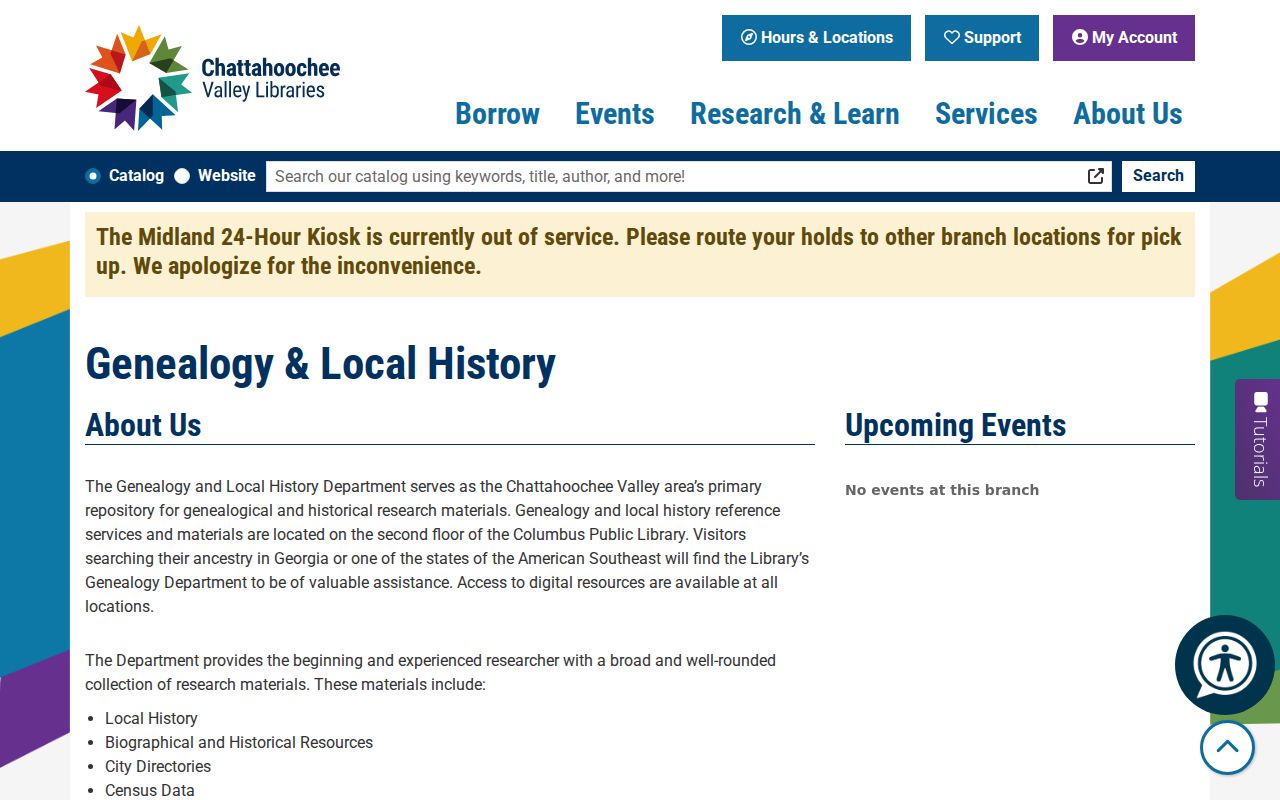
Some routes work only inside the library. Ancestry Library Edition is in-library, while FamilySearch affiliate images may unlock only at the branch with a free personal account. Fold3, GALILEO, Georgia Historic Newspapers, NewsBank, and MyHeritage provide companion searches under their stated access terms.
When an exact year is absent online, ask staff to check the physical shelf, nearby years, telephone books, and Phenix City volumes. A short request with name, year range, address, and one known relative is more useful than an open-ended search.
Columbus Directories Cross the River
The 1894 Zorn directory deliberately combines Columbus with Phenix City and Girard, Alabama. Later verified volumes also include cross-river places. This is a key geography clue: a person can disappear from the Georgia alphabetical list yet remain nearby, connected by work, family, or a move across the Chattahoochee.
Search both sides before concluding that a household left the area. Keep the city label attached to each entry because the same street name may exist in more than one jurisdiction. Columbus and Muscogee consolidated in 1971, but Alabama records remain under separate custodians.
Columbus Directory Sources at CSU
Columbus State University Archives holds city and limited Phenix City directories, telephone books, city and county reports, codes, land-use records, maps, and large architectural and survey collections. These sources can connect a directory address to an architect, owner, development, or neighborhood change.
The CSU local holdings page shown here identifies that wider archival setting.
Reading-room access matters because many oral-history recordings and archival items are not fully online. The Edge R. Reid Collection preserves negatives tied to the first city directory, early maps, and newspapers. Those copies help explain why a scan, reprint, OCR file, and original volume may not look identical.
Columbus Names Before State Registration
Columbus began city birth and death registration in August 1890, well before Georgia's statewide system began in 1919. The library indexes a birth run through 1918 and has early death, marriage, obituary, and newspaper tools. A city directory name can therefore be checked against unusually early local event evidence.
- 1859-60: the first verified digitized Columbus city directory supplies an early name, trade, business, and street baseline.
- 1890: Columbus begins city birth and death registration, creating a local event trail before statewide registration.
- 1919: Georgia begins statewide birth and death registration, shifting later certificate research toward DPH and the local vital office.
- 1971: Columbus and Muscogee County consolidate, producing the modern near-coterminous local records geography.
Georgia Archives vital-record guidance explains the larger state and county research landscape.
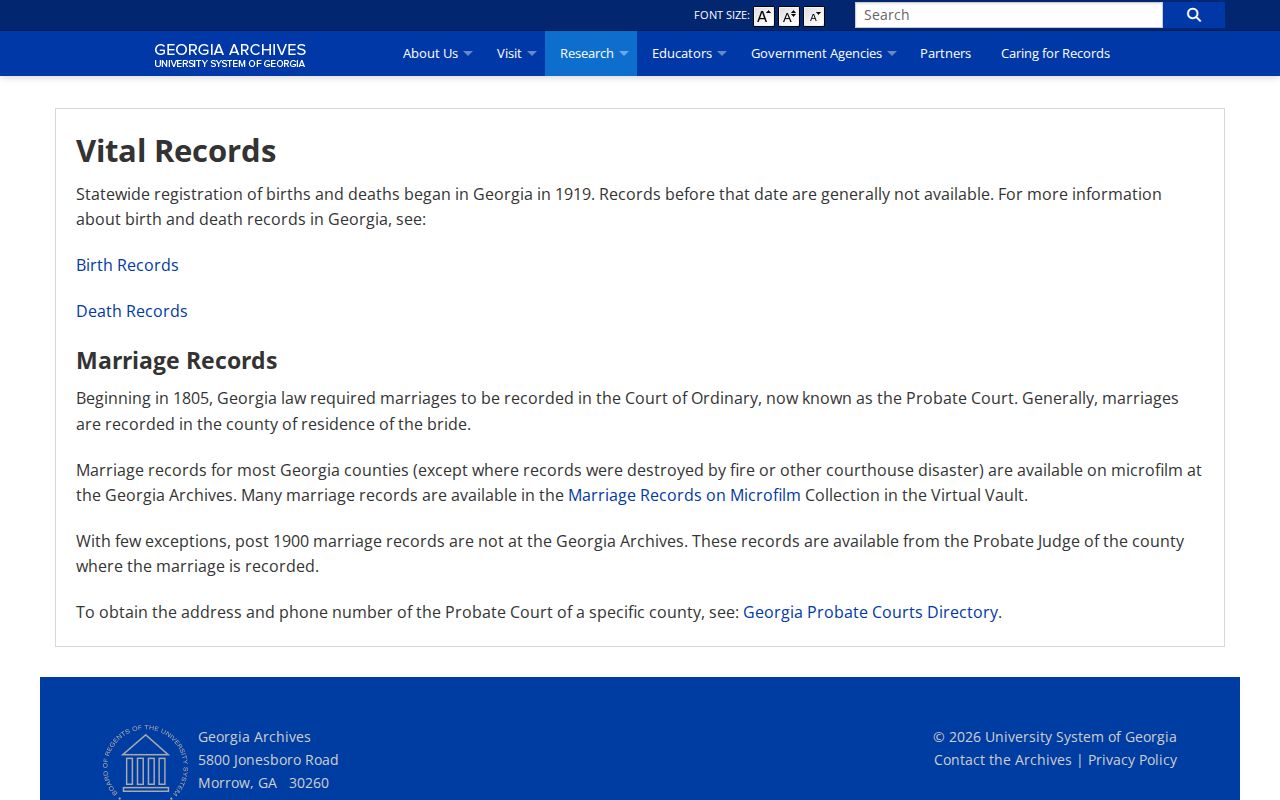
The archives generally leaves county originals with local custodians but offers pre-1900 county microfilm, Virtual Vault material, and research guides. An index helps locate an event. It does not replace a certified record or override Georgia eligibility rules.
Extend Columbus Directory Evidence
Sanborn maps add the building that a directory entry alone cannot show. Verified Columbus map years include 1885, 1889, 1895, 1900, 1907, 1918, 1921, and 1923. They record footprints, use, construction, doors, windows, water facilities, boundaries, and house or block numbers. They do not provide a complete occupant list.
Georgia Historic Newspapers covers 27 Columbus titles from 1828 through 1893 with gaps. Local resources also note the Columbus Ledger from 1903 to 1988 and Ledger-Enquirer text from 1993. Search the directory's exact address, employer, and name together. Then use the municipal cemetery database and will-book index as leads for a person who disappears.
Note: A cemetery or obituary result should be reconciled with probate or an official death record before drawing a firm family conclusion.
Why Columbus Households Disappear
Disappearance from a city directory does not always mark one person's move or death. A Columbus brownfields narrative reports that target neighborhoods lost 59 percent of their population from 1960 to 1980 and that 900 units were demolished amid military relocation and urban renewal. Whole blocks could change at once.
Compare the last listed address with maps, permits, demolition records, newspapers, and the next available directory. Central Columbus and the older Wynnton and MidTown corridors have deeper historical map coverage, while newer north and northwest growth often depends more on assessor, GIS, and permit evidence.
Trace Families in Columbus Directories
A good family trail treats each Columbus city directory as a dated snapshot. The federal census supplies household composition, age, and birthplace. Annual or near-annual directories can narrow moves and changes in occupation between census dates. Public census schedules now run through 1950 under the National Archives' 72-year rule.
- Search the closest year by surname. Copy the spelling, initials, trade, firm, and residence exactly from the page image.
- Open the prior and next available editions. Note the first appearance, address change, work change, and last appearance without assuming why a gap occurred.
- Use the street guide to check the number between cross streets and to see nearby listed occupants, businesses, or vacancies.
- Pair directory years around 1900, 1910, 1920, 1930, 1940, and 1950 with the matching public census schedule.
- Search local newspapers, obituary and death indexes, cemetery entries, and Muscogee probate when the dated trail ends.
A vanished listing can mean a move, death, omission, publication gap, or OCR failure. Two independent matches, such as spouse and address or occupation and middle initial, are safer than a shared name. When the research shifts to present-day official records, use the Columbus resident lookup rather than projecting an old listing forward.
The CSU Typewriter Portrait index adds more than 900 Sunday profiles from 1949 through 1969. It can bridge a brief directory line to a richer, dated account of a Columbus resident's civic, family, or business life.